Before the Online Group: How Neighbours Kept a Shared Record
See how neighbors used notebooks, minutes, calendars, maps, and doorstep messages to preserve local decisions—and what those records could and could not tell them.
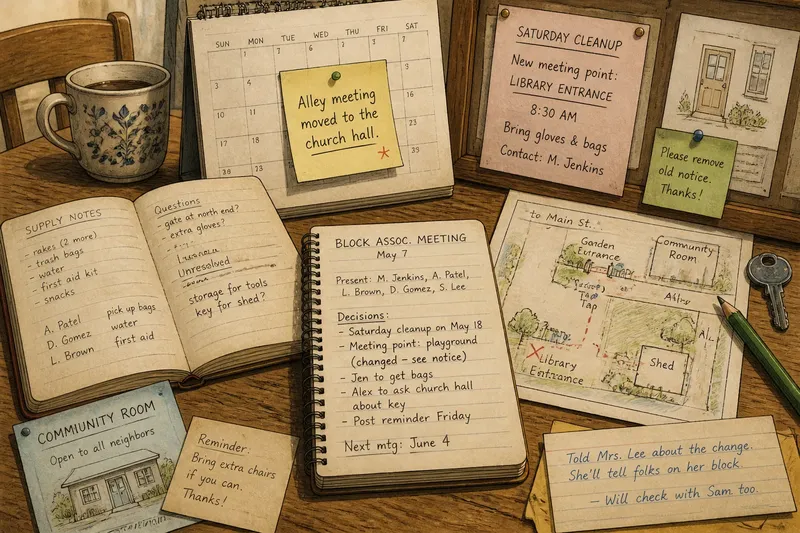
A handwritten note on a kitchen calendar says the alley meeting has moved to the church hall, but it does not say who changed the venue or whether the next meeting will be there too. Before online groups, neighbors had to make records legible across kitchens, porches, meeting rooms, and changing households. Their methods were modest, but each solved a practical problem: carrying a message, remembering a decision, or showing where a shared task stood.
Those records were not a single, orderly archive. They were a mix of notebooks, meeting minutes, household calendars, route maps, flyers, and spoken messages passed from door to door. Looking at how each worked reveals both the strengths of local memory and the gaps that came with it.
How did neighbors pass along news?
For a gathering or workday, one neighbor might tell nearby households in person, while a handwritten notice went on a community-room door or shop window. A message passed along a familiar route could reach people who did not attend meetings or check a noticeboard, but each retelling could lose a detail or leave someone out.
Paper notices made the practical facts visible: the place, the task, and whom to contact. They were easy to read without an account or device, though a notice left up after plans changed could become misleading. People often relied on the person who posted it to replace or remove it.
Say a block association plans a Saturday cleanup and the meeting point changes from the playground to the library entrance. A neighbor updates the noticeboard and carries the news to households on the usual walk, then asks the meeting secretary to mention the change at the next gathering. The expected result is that the message reaches people through more than one route, while the posted notice gives late readers one visible version.
What did notebooks and minutes preserve?
A shared notebook could travel with the person arranging supplies or stay in a familiar place, such as a community room. Neighbors used it to jot down requests, names, tasks, and unresolved questions. Its value came from being close at hand; its weakness was that entries depended on a writer’s shorthand and someone remembering to bring the book back.
Meeting minutes served a different purpose. They captured what people discussed and, ideally, what they agreed to do. A useful minute named the decision and the responsible person rather than recording every remark. When no one wrote down the reason for a choice, later readers could mistake a temporary arrangement for a permanent rule.
Minutes also reflected who was present. Someone who missed a meeting might learn the outcome later, but could not necessarily tell whether a decision had been final, tentative, or open to revision. Groups sometimes addressed that gap by asking a neighbor to relay the result or by posting a short written account where others could see it.
Why did calendars and maps matter?
Household calendars gave recurring activities a place in daily routines. A note on a kitchen calendar might remind one household to open a room, bring a key, or set out chairs. Such reminders worked well for the people who could see that calendar; they were less dependable as a shared source once plans crossed household boundaries.
Hand-drawn maps helped neighbors coordinate in places where street names alone were not enough. A sketch could mark a garden entrance, a water tap, a meeting point, or the route for carrying supplies. Notes on the map could make local knowledge visible, but an undated sketch might outlast the path, gate, or arrangement it described.
A map was often strongest when paired with a written instruction or a person who knew the place. Without that context, a symbol understood by one household could be puzzling to a newcomer. The map showed where; a note or conversation explained what to do there.
What could these old records tell you?
Paper traces offer clues, not automatic proof of what a group decided. Check the date, the writer or source if known, the intended audience, and whether a later record changes the arrangement. When those details are missing, preserve the uncertainty instead of filling it with a guess.
- Check a notice for a date and a named contact; if both are present, treat it as a useful lead, and if either is missing, ask someone familiar with the event before acting on it.
- Check minutes for clear decision language; if they distinguish an agreed action from a proposal, use that distinction, and if they do not, confirm the status with the group.
- Check a notebook entry for the writer and surrounding notes; if the meaning is clear in context, retain that context, and if it remains ambiguous, mark it unresolved rather than rewriting it as fact.
- Check a calendar note against later meeting notes; if the dates agree, use the calendar as a reminder, and if they conflict, ask which schedule was current.
- Check a map for labels and signs of later changes; if its landmarks still match the place, keep it as a guide, and if they do not, annotate it or set it aside as historical.
- Check a passed-on message against a posted notice or written record; if they match, share the consistent details, and if they differ, pause and contact the organizer before spreading either version.
How can you read a paper trail without guessing?
How can you tell whether a note records a decision?
Look for wording that says what the group agreed to do, along with a date or meeting context. If a note only records an idea or request, treat it as a proposal until another source confirms the decision.
What should you do with an undated map?
Compare its landmarks and instructions with the place as it is now, then ask someone who knows when it was drawn. If its age cannot be established, label it as undated rather than using it as current directions.
What if two paper records conflict?
Keep both records visible and identify the disagreement instead of silently choosing one. Ask the people responsible for the initiative which arrangement was adopted, then note the clarification alongside the conflicting material.
Why might a message have missed some households?
A noticeboard or doorstep route reached only people who passed that place or were included in that route. Check whether another channel was used, and avoid assuming that silence meant a household had received or accepted the message.
What is not worth preserving?
Not every scrap deserves careful copying. Duplicates, unreadable fragments with no useful context, and old reminders that explain nothing can consume attention without helping anyone understand the initiative. Keep material that sheds light on a decision, a place, a routine, or a change neighbors may need to understand.
When an old calendar note, map, or minute survives, its gaps are part of the story too. A record can show how information moved through a neighborhood while reminding readers to ask who received it, what was agreed, and what remains uncertain.